Rachel Daucé – I love the buzz of towns, but I definitely need silence to function
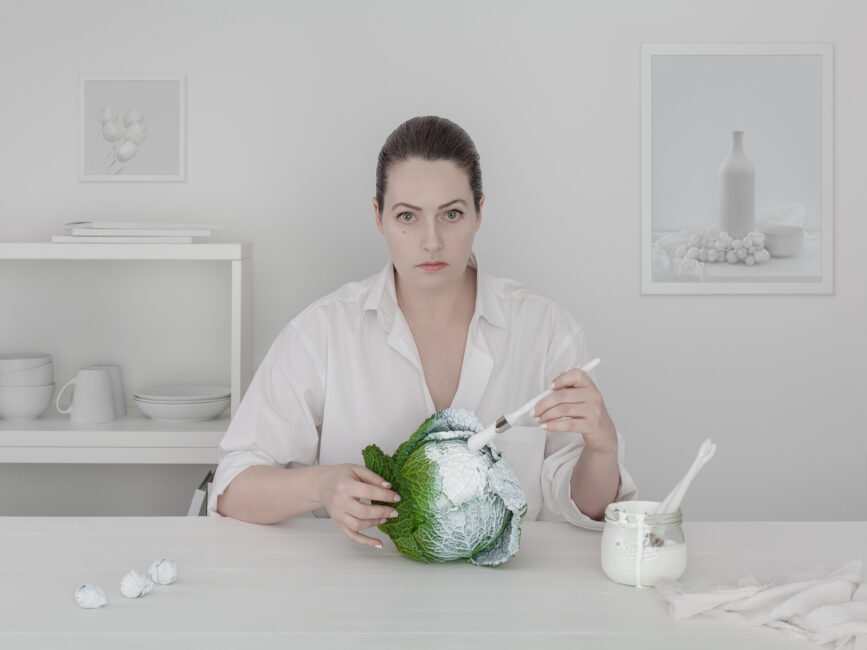
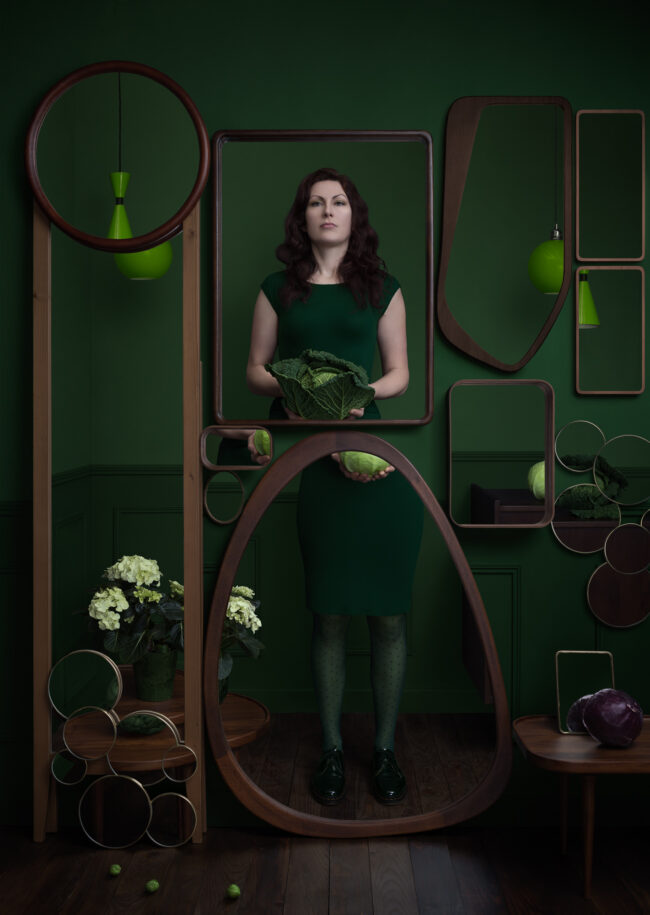
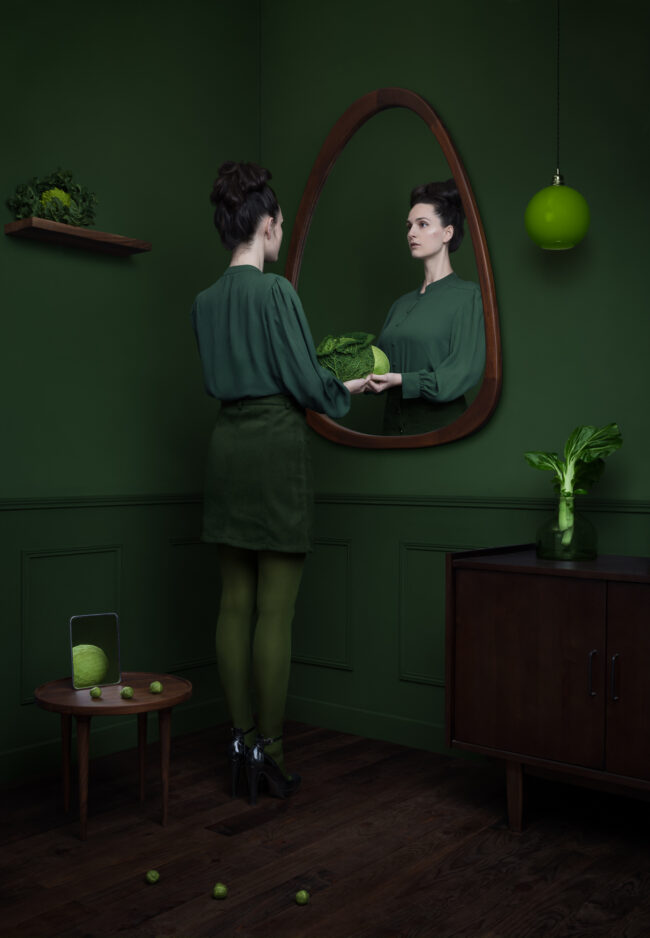
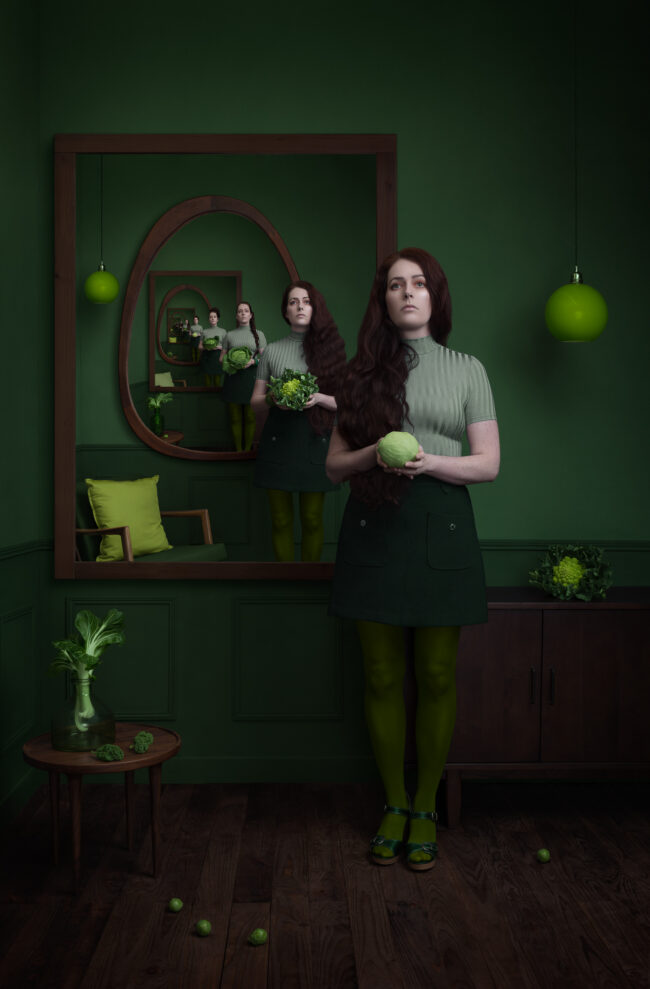
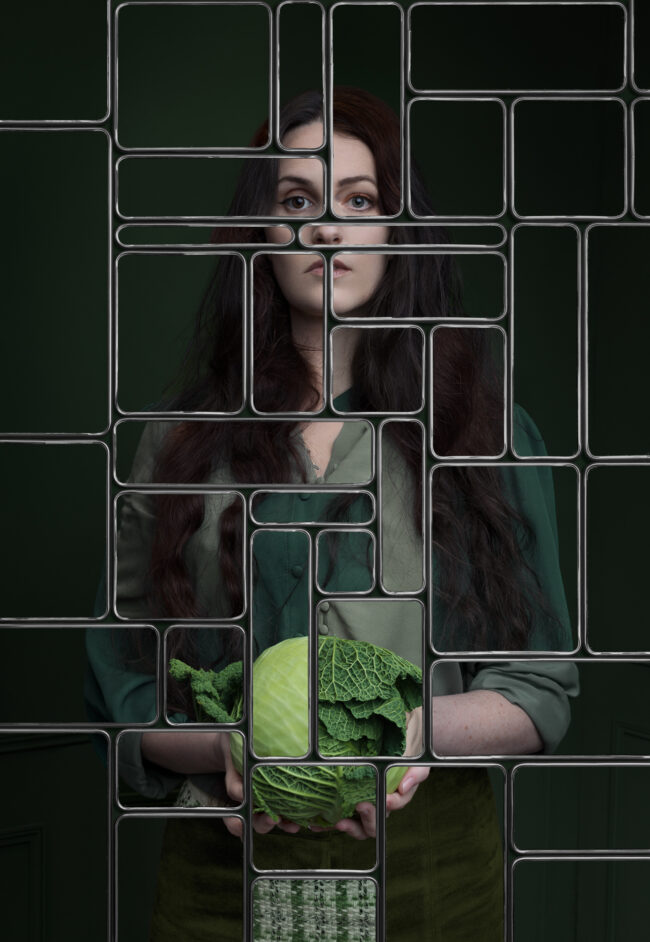
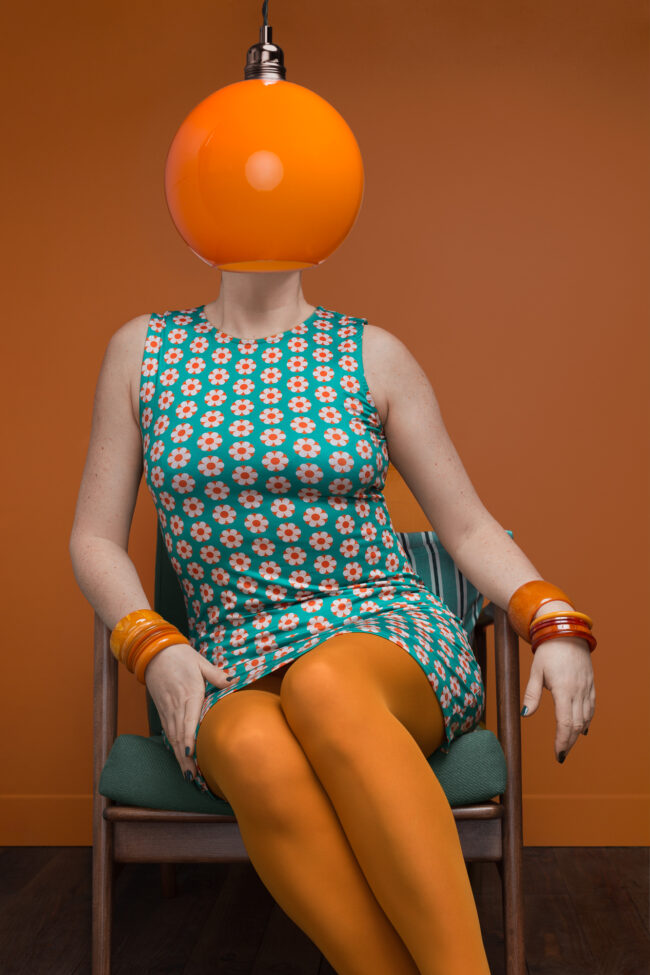
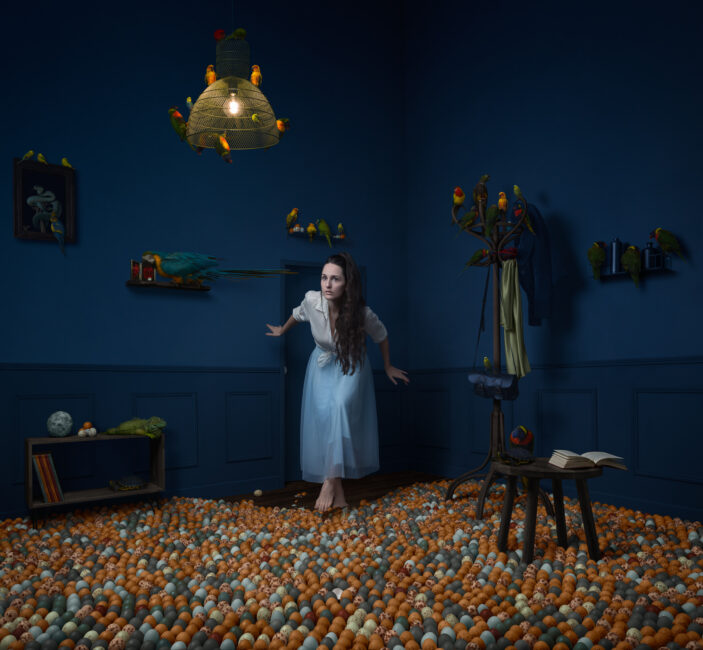
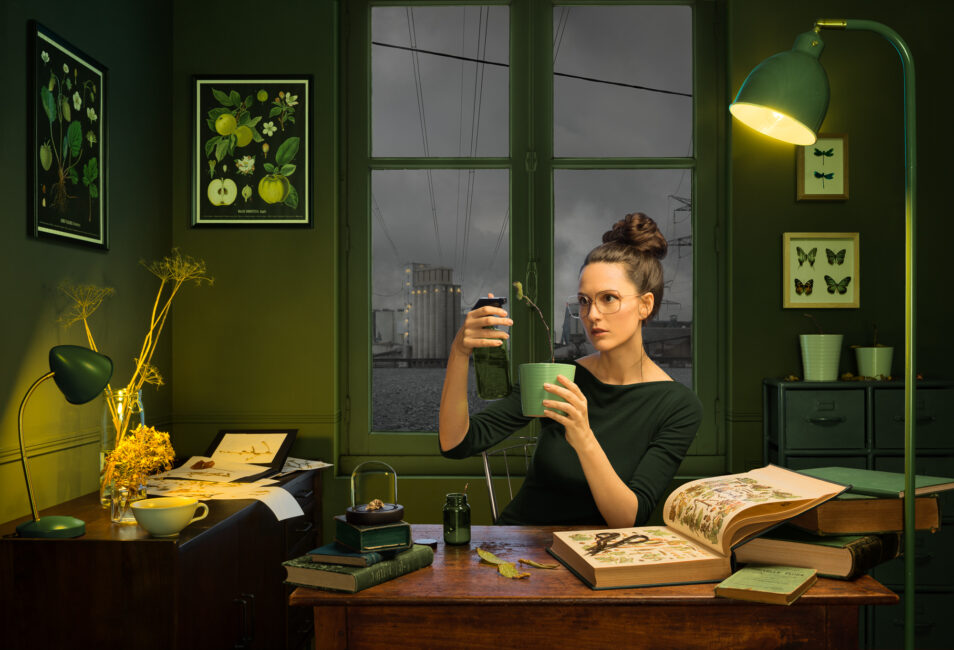
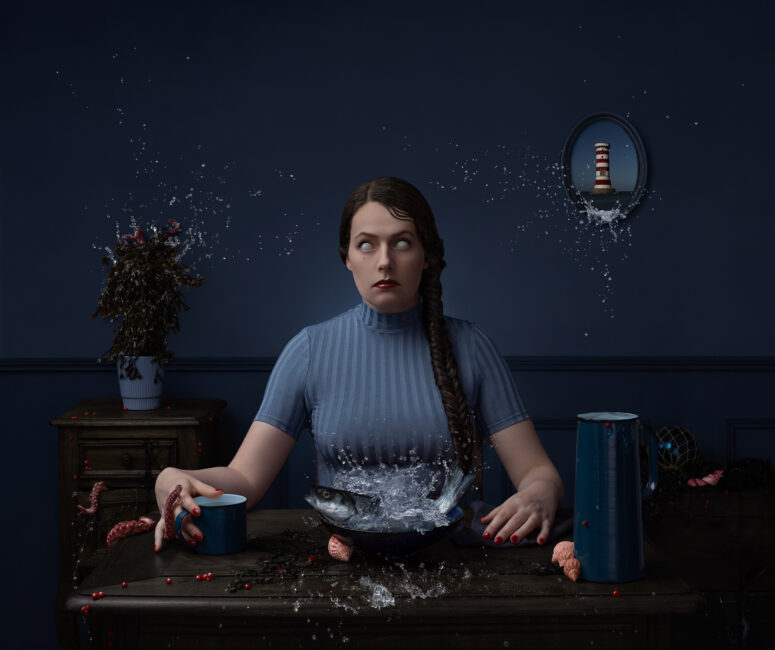
Focused on idiomatic expressions, the Literally series aims at questioning the language and its subjectivity, and by extent, our relation to others and to reality.
Very metaphorical by essence, idiomatic expressions distort the actual sense of usual words to create a new meaning.
As Magritte denounced the “treason of images”, the photographer here stages the treason of words, calling upon the photographic language and the universal nature of images in order to reduce them to their literal meaning before giving them a new significance.
In colourful, multi-layered compositions, the photographer tackles various relevant modern topics and let ultimately the viewer come up with its own interpretation.(Images have been produced without the use of AI.)
Rachel Dauce
How do you experience the mechanism of language in your life and your creative process?
Language tends to play an important role in my everyday life, as I’m also working as a freelance translator.
Having been initially trained as a chemist, though, I have a very clinical approach to language: I tend to think it should allow us to communicate very accurately what we mean, even the smaller nuances of our thoughts, so I very much wish it were unequivocal.
In my creative process, I’d say language is pivotal in a dual way: on one hand, I sometimes read an expression, a sentence, which triggers some emotions I feel compelled to translate into images.
On another hand, I’m utterly unable to express my feelings through words. I’m not sure if it’s due to the fact that I come from a region and a social class where resilience is seen as the utmost quality while emotions are considered a weakness, so I was never used to voice my feelings as a kid, but there it is.
It’s tons easier for me to express myself with images.
Rachel Dauce
How much space do words allow for ambiguity?
First of all, I think it depends a lot on the language. Let’s consider the case of the possessive article, for instance. In English, the inflexion takes the form of the gender of the person owning the object, and in French the form of the object which is owned. In both these languages, it introduces a degree of uncertainty depending on the syntax, and a lot of authors have leveraged that ambiguity to create misunderstanding for comical or poetical effect throughout the centuries.
In German, on another hand, the possessive article differs with both the genders of the object owned and of the owner, leaving no place for doubt whatsoever.
What fascinates me most, though, is idiomatic expressions: their literal sense deviates so much from the commonly admitted meaning.
Where Magritte was talking about the “treason of images”, I resent the treason of words. Resent is perhaps a bit too strong a word, but I find it a bit scary that a chain of words which is supposed to have a given meaning, the only way human beings have to convey their thoughts is actually not solid but shifting. Somehow, if you caricature the situation, you end up with everyone giving an individual meaning to words and sounds, one language per person, and a total inability to communicate, which implies total loneliness.
Rachel Dauce
In your photography series Literally, words don’t simply describe the image, they intervene in it, almost physically. In an age of overexposure to information, do you feel that words have become a weight we carry, shaping our lives?
Words in themselves are harmless, it’s the intention behind them which does shape our lives. But yes, in that sense, they do. The injunctions we have to face in our daily lives grow more numerous by the day.
It gets harder to cut ourselves from these words, from all the opinions which are voiced daily. I’m trying to cut a lot on social media, for instance, as algorithms gets better at targeting the content we like, I realized I was ending up comforted in my opinions, that the “reality” social media showed me was utterly biased, even when I tried to balance my information sources.
I ended up developing a very acute eco-anxiety, and of course the biodiversity is dwindling and global warming is very real. Yet I was so bombed with this type of content that indeed it began to affect everything I was doing.
Rachel Dauce
Your photographs don’t only show what is, they also show what is said about what is. How do you relate to the idea of truth in art? Is there, for you, such a thing as “visual honesty” in photography?
I don’t think photography has a veracity quality, whatever the type of photography. Even in documentary photography and photojournalism, which by essence aim at describing the “truth”, if such a thing exists, the choice of lens, angle, framing or the light, all influence the way the viewer will experience the image.
And then, if the photographer is at one hand of the “photography chain”, the viewers are at the other end, and they also come with their own set of beliefs, culture, personal experience. This means that even if a photography of the truth could exist, no two persons would experience it the same way.
Now, the type of photography that I do is by essence “untrue” in the strictest meaning, in the sense that I composite and collage elements to create my own universe. I tried commercial photography some years ago, mostly weddings, an industry in which you have to please. I didn’t feel fulfilled, so I called it quits and started the Literally project a few years afterwards, deciding that I didn’t care if people liked it or not.
It was extremely liberating to let go of the need for validation, the social media CTA, the injunctions, to be profitable.
So in that sense, my photography is as honest as it can be, as I don’t do it to please or influence people. I see it more as a way of communicating as a language in itself.
Some people see things in my images that I haven’t put, and that’s beautiful. Occasionally, some people find one of my images crystal-clear, and it deeply resonates with them. It’s always very moving when it happens.
Rachel Dauce
Do you see humour or irony as a way to survive emotional saturation?
Definitely. In any given situation, I’m always very sensitive to the absurd, the derision. I’m keen on self-mockery on an everyday basis.
For me, beauty, or the attempt at crafting something beautiful, also plays the same role.
I’ve been very much involved against my will into two conflictual situations that I can’t avoid lately, and I really feel the need to tap into the negative emotions those conflicts triggered in me and to transform them into something beautiful, or at least meaningful.
I’m working on that image at the moment, but it’s going to be called “Du fil à retordre”, which is employed when someone gives you a hard time. Literally, it means “some thread to retwist”, but it’s one case of ambiguous idiom: “fil” means both “thread” and “wire” in French, and I always thought that it was about wire. So, I decided to leverage that ambiguity in the image.
Going back to the topic, I feel that if I exalt my anxiety or my longings, they’re a lot more bearable. And of course, I think absurdity can be ironic, but also very poetic and beautiful.
Rachel Dauce
What happens when you strip language entirely from an image? Could your work be seen as an experiment in what is gained, or lost, when text is introduced to a visual experience?
If the inspiration for my images are words or expression to start with, I like to think they can be read on different levels.
My first aim is actually to strip the expressions of their initial meaning by taking them literally. I do give them a new meaning, but I don’t articulate it in words.
I put a lot of things in these images, emotions, remnants of dreams, concepts and even private jokes sometimes, but I don’t think the viewer needs to know that to experience my images, to relate to them.
In a way, words are the vessel for my inspiration, they do link my subconscious to my conscious mind, which then translates things into images.
They also trigger the interest of the viewers, who very often end up telling me: “Don’t tell us what the idiom is, we want to find out by ourselves!”. So, I would say that both for me and the viewers, they do play the role of gate to the visual experience.

Rachel Dauce
Can language itself be felt, not just understood? Can a word behave more like a texture than a meaning?
That’s a very tough one. Obviously, tone and tonic accents play a huge part in the way a sentence or a word is perceive. For instance, Swedish and Norwegian are rather similar, yet the Norwegians use stronger tonic accents, which gives their sentences a very chanting quality. So, a Swede talking with a Norwegian will think the Norwegian is very happy, even if that’s not the case.
At the word scale, I wouldn’t say so, or at least not for me.
When I read a word or an expression that I like, though, it triggers an image right away. I immediately associate with colours, but then I have to let the image grow, to nurture it slowly, so that it makes some new sense and that all the parts come together, like a big jigsaw puzzle.
But I imagine that the word-colour association is quite universal, or at least rooted in the occidental culture. Let’s take the word “ominous”, for instance. I don’t think the sound it makes is very threatening. But on another hand, in the collective imagination, people would picture something dark grey, possibly with tints of blues and greens.
I think the cinema plays a big role in that, we’ve been taught to associate concepts with trendy or intemporal colour schemes.
Rachel Dauce
Do you ever find yourself resisting language, or craving silence?
I was raised in France, so for a long time, I was pervaded with the French culture attitude towards silence. The French are always talking. Silence is somewhat considered as a sign that you’re very bored or having a bad time with the people you hang out with, so as soon as two French people get in contact, they launch into endless small talk interspersed with more meaningful partaking of information.
In France, the fact that you have “nothing to say” is hardly a good reason to shut up, so there’s always some kind of background noise to any human interaction.
I’m not sure what’s the Greek approach, but I imagine that it is pretty similar to the French one. I moved to live in Sweden for a couple of years at some point, and there I discovered that after exchanging the usual information, like how is everyone doing and what are the latest news, it’s perfectly OK to stay silent, even with a group of friends. After such a moment, a friend asked me why I’d come to live in Sweden, as the winters are pretty tough and France seemed much more pleasant to him. I told him that it was partly because such moments as the one we’d just had were impossible in France. He was appalled and answered: “Really? It must be hell”.
Now I’m back in France, but I’ve decided to settle in the countryside. Long, silent walks are very much part of my creative process. That’s when my mind unwinds. It sorts the experiences of the day or sometimes of the past weeks, and then ideas pop up by themselves.
I love the buzz of towns, but I definitely need silence to function.

Rachel Dauce
What are your plans on advancing with your photography?
First of all, I’m renovating a specific place in my house which will be my studio. I’m not sure what are the paths to progress for other photographers, but I really need more space to go further with my lighting.
Also, I’m not really good at visualizing things in 3D in my head, and despite sketching rapidly my scene on paper before shooting it, I often overlook the finer details which play an important role in my imagery.
So, I definitely want a dedicated space where I can keep my set on until I have assembled each image.
I was also very happy to see my work exhibited at VIF festival during spring, a French photo festival. Later this autumn, I’ll also be part of a joint exhibition catered for by Kamira Institute in Paris, and I hope very much to be part of other thrilling events in the next future.
Rachel Dauce
Info:
Self-taught photographer, Rachel Daucé has explored various techniques before identifying her medium of choice: composite photography, which allows her to create colorful images from scratch with a marked surrealist expression, without the help of AI.
A photographic report on the work of the technicians at the Royal Theatre in Stockholm provided her with the skills she needed to create her own sets, but also a recurring theme in her work: the insignificance of humans in relation to the world in which they live and the futility of their efforts to free themself from it.
Her work as a translator lead her to question language and gave a new momentum to her photographic research, which currently focuses on identity, the perception of others or climate change.
Recognized by various international awards, her work has also been exhibited at Vincennes Images Festival this spring and will be part of a collective exhibition by Kamira Institute in Paris in November.
Rachel Dauce