Sadiq Al-Harasi – I don’t like to identify myself as an artist or photographer but more as a storyteller
I’ve spent my life searching for my father, trying to piece together the fragments he left behind. I’ve longed to hear his stories; his adventures, sacrifices, and countless journeys. His absence compelled me to delve into the remaining physical archives of our family. But I wonder, does the past exist as we remember it? How far does memory stretch across the distance created by time?
My ongoing project, “What Do Fathers Leave Behind?” is an autoethnographic exploration of the absence. It materialises the loss of a father, identity, and the past and future selves of both my father and myself. Through this project, I explore the intricate relationships among identity, loss, belonging, and memory, using family archives, photography, writing, and sound. I am particularly interested in the intersections of these media and how they can collaborate as tools to construct an experimental memory landscape.
Sadiq Al-Harasi

Sadiq Al-Harasi
Your project unfolds as a personal search. Did you begin with a visual strategy in mind, or did the narrative evolve organically as you gathered stories from your past?
To be honest, the project started as a zine. I made it as a part of an online zine workshop with Andreas Laszlo Konrath, organised by Tasweer Photo Festival. It began as a self-exploration of the family archive, mixing text, collage, and stitching of damaged images from the family album. I was later accepted into the ADPP (Arab Documentary Photography Program), where I developed the project, and the narrative evolved organically. I developed a style and visual language that represented my feelings during that stage of searching.

Sadiq Al-Harasi
Did the act of photographing your family, your village, and personal objects change how you remember your father?
For sure, but I’m still concerned about the way I remember him, and I question whether those memories are real, or I simply constructed them to fill my need to have a father like others my age.
Through the project I was trying to rebuild his presence and reconstruct an image of the way he lived and what he experienced in his life.

Sadiq Al-Harasi
How do you balance the emotional weight of loss with the discipline of documentary storytelling?
Actually, it wasn’t easy at all. I went through a lot of ups and downs, as I was encouraging my memory to remember everything that I lived with my father. I talked with my mom and family members about him and their memories of him as well. It was tough to hear many of the stories he was supposed to tell me directly from them. As my mom said, death is exhausted. I wrote about a lot of memories and feelings. I guess this helps a bit, but not that much.

Sadiq Al-Harasi
Memory can be both personal and collective. Do you see this work as a universal story about identity and inherited narratives?
I think loss is a collective experience; we have all lost someone at a certain time. I started the project looking for my father, but I ended up finding so much loss. And through this journey I found so many people that had not lost their fathers per se, but they don’t have a good relationship with them. I saw it as a mutual narrative about identity, in a way, and how a father’s absence or presence can affect our identities.
I’d love for those who see my project to feel that, to remember their losses in the first stage, and then maybe to articulate their feelings about their fathers. It’s not necessary to have a great father, but it’s nice to see the other side of the relationship, and maybe share their thoughts and experience of it.
I also found that I romanticised my feelings of growing up without a father, and that sometimes absence is better than a harmful existence.

Sadiq Al-Harasi
Were there images you withheld because they felt too intimate, or images you kept precisely because they crossed that threshold?
Definitely, there were so many moments and images that I felt were for my family and me, and it’s not going to be part of this project or open for everyone. In addition to that, I’m coming from a tribal background, and it’s not allowed to show women’s faces or photograph them, it is considered shameful; this is why I decided to create some images in a way that doesn’t show a clear portrait of my mom or sisters.

Sadiq Al-Harasi
Did audio, text, or other media ever play a role in the edit room or your thinking, even if they didn’t make the final cut?
Yes. Actually, I don’t like to identify myself as an artist or photographer but more as a storyteller, therefore, I utilise different media in telling my stories. I used installation, text, cyanotype, collage, photo-transfer, stitching, audio, and filming in this project. I experiment with different tools and media to convey the way I see and feel my story.

Sadiq Al-Harasi
What role does silence play in this project, visually, emotionally, and narratively?
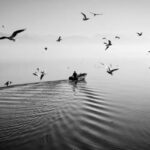
I guess silence plays a crucial role in my project. I chose B&W to convey this idea of silence, visually. When we lose something, we start to feel silent, we lose our way of expression and talking out loud. This is why I was trying to do the same, I didn’t include voices in the narrative to keep the silence and to make everyone feel the same or in better words, to feel themselves in the project and to blend in with it.

Sadiq Al-Harasi
Do you see this work primarily as an act of preservation, reconciliation, or confrontation, and why?
Actually, I can say all of the above. When I started to work on the project, it was about preserving my family’s memory and our shared experience of losing my father. But then it organically changed to be an act of confrontation; to confront my memories, my loss, and my feelings of weakness. After that, a reconciliation of growing up without a father, and accepting the idea of his death after seventeen years of ignoring this fact and symbolising him in everything.

Sadiq Al-Harasi
What would be lost if this project were declared finished too soon?
To be honest, I can’t see the end of this project so far. It’s a lifelong project for me. The search journey didn’t end yet, and I feel I’m lost in the project as well. I was searching for my father, but I lost many other things on the way; therefore, I should work on finding them and finding me.

Sadiq Al-Harasi
Info:
Sadiq Al-Harasi is a Yemeni photography-focused emerging artist and independent cultural practitioner. He holds a BSc. in Architectural Engineering from Sana’a University.
Driven by the desire to explore hidden truths and challenge societal narratives, Sadiq creates thought-provoking and autobiographical artwork that delves into themes such as memory, identity, death, loss, and belonging. He is particularly captivated by the expressive power of the human form, using it to explore the intricate connections between culture, identity, and the dynamic interactions between individuals and their surroundings.
His artistic practice spans various media and has been exhibited locally and internationally, including Slidefest SAFAR – Peckham 24, Image Festival Amman 2025, LagosPhoto Biennale 2025, and VAiF 25.